First published 20 July 2025
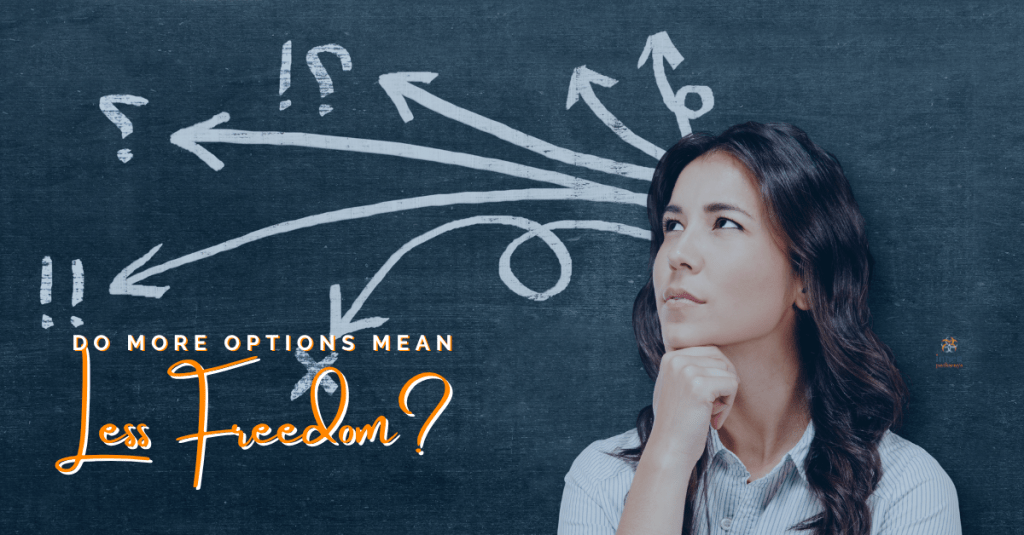
When More Options Mean Less Freedom
This email came out a little later than planned, and there’s a rather fitting reason why.
I sat staring at my laptop for ages on Thursday, paralysed by indecision about which of three topics to write about.
The irony?
The topic that eventually won was decision fatigue.
Sometimes life has a sense of humour, doesn’t it? (oh who am I kidding – never mind sometimes, it’s most of the time!)
This mental wrestling match has been on my mind ever since I read “The Paradox of Choice” for my book club last month. Barry Schwartz makes a compelling case that while choice is supposed to liberate us, too much of it actually leaves us anxious, overwhelmed, and oddly less satisfied with whatever we eventually pick.
Then, I was doing the garden while listening to the audiobook “Peak Performance” by Brad Stulberg and Steve Magness, I came across something interesting.
They meandered into the topic of decision fatigue too – the angle they took was to discuss some of the world’s most successful people and how they have deliberately eliminated countless small decisions from their daily lives.
The Uniform Revolution
Have you ever noticed Mark Zuckerberg’s endless grey t-shirts, Steve Jobs’ black turtlenecks and jeans.
These weren’t fashion statements – they were strategic decisions to preserve mental energy for what really mattered. When I spoke to my brother when I was trying to decide on this week’s topic, he commented on how his ‘work uniform’ was similarly reduced to a particular colour of t-shirt and how many of the ‘same’ t-shirt he now owns, just so that he can also eliminate this decision in the mornings.
It got me curious though – I couldn’t immediately think of any high-profile women who’d adopted this approach. Is that because women face different societal expectations about appearance and variety? (is there a link to the emotions mail I sent 2 weeks ago here? – if you missed it, I promise the blog with past mails will be updated soon!)
Or is this because we are conditioned to believe that having lots of choices is inherently good, even when it exhausts us?
The Energy Drain You Don’t See Coming
From a kinesiology perspective, every decision – no matter how small – requires energy. (that’s why in a session I aim to reduce to a minimum the number of questions I ask a client’s system)
Your nervous system doesn’t distinguish between choosing which cereal to buy and choosing which career path to take.
Each choice activates the same neural pathways, depletes the same glucose stores in your brain, and contributes to that end-of-day feeling of being absolutely shattered despite not having “done much.”
In Traditional Chinese Medicine, this kind of mental spinning is often linked to an imbalance in the Spleen energy system. The Spleen governs our ability to process not just food, but information and experiences.
When it’s overwhelmed by constant decision-making, we can feel scattered, indecisive, and mentally foggy – that familiar feeling of “I can’t think straight.”
And taking it a step further, your solar plexus chakra – considered the personal power centre – can also become depleted when it’s constantly engaged in low-level decision-making.
Instead of being available for the big, meaningful choices that align with your values and goals, it’s been frittered away on whether to have toast or porridge for breakfast.
Peak Performance covered this by talking about physically exercising to the point of fatigue is no different to ‘thinking’ – if we are focused completely on a mentally taxing task, it can lead to the same fatigue.
The Paradox of Infinite Choice
Here’s what’s fascinating: research shows that when we have too many options, we often end up:
- Taking longer to decide (hello, 20 minutes spent choosing what to watch on Netflix – I think the last time I tried to pick something on Netflix I took so long trying to find something I wanted to watch that I gave up and switched the telly off!)
- Feeling less satisfied with our choice (constantly wondering “what if” – my most common example of this is a menu in a restaurant, especially if someone else picked my second choice!)
- Avoiding decisions altogether (decision paralysis – I know this one well)
- Defaulting to whatever’s familiar (so much for all those options)
Think about your local supermarket. There are over 300 types of breakfast cereal available. Genuinely, over 300. How is that helping anyone have a better breakfast experience? (this could be why I have decided to cut out breakfast altogether!)
The Autopilot Trap
But here’s where it gets tricky.
Eliminating trivial decisions can free up mental energy, but, we need to be careful not to sleepwalk through life entirely.
There’s a difference between streamlining the mundane and disengaging from meaningful choices.
I see this a lot in my work – people who’ve become so overwhelmed by choice that they’ve handed over all their decision-making power.
They let their partner choose the restaurant, their boss dictate their schedule, their friends decide their weekend plans.
It feels easier in the moment, but it’s a fast track to losing touch with who you are and what you actually want.
From an energetic standpoint, this kind of chronic people-pleasing creates a disconnection between your heart centre (what you truly want) and your throat chakra (your ability to express and act on those desires).
You can end up feeling like you’re living someone else’s life.
The Sweet Spot of Conscious Choice
The goal isn’t to eliminate all choice – it’s to become more intentional about where you spend your decision-making energy.
Automate the trivial: What could you standardise in your daily routine? Maybe it’s having the same breakfast or lunch every weekday, laying out clothes the night before, or having a set “uniform” for certain occasions.
Preserve energy for what matters: Use that saved mental bandwidth for the decisions that actually impact your wellbeing, relationships, and goals.
Notice your patterns: Are you someone who gets overwhelmed by too many options, or do you thrive on variety?
There’s no right answer, but knowing your pattern helps you structure choices in a way that works for you.
Your Decision Audit Challenge
This week, I’d love you to become a detective of your own decision-making:
Track your choice fatigue. Notice when you feel that familiar overwhelm creeping in.
Is it when you’re choosing what to wear, what to eat, which route to take, what to watch?
Where are you spending precious mental energy on things that don’t really matter?
Identify your “Zuckerberg moments.” What small, recurring decisions could you eliminate or streamline?
Could you meal prep the same breakfast for the week (overnight oats could be made on a Sunday night for the whole week)?
Create a capsule wardrobe?
Set up standing orders of direct debits for all your bill payments?
Check in with your body. When you’re faced with too many choices, where do you feel it physically?
- Tight chest?
- Scattered mind?
- Heavy shoulders?
Your body’s wisdom often knows when you’re in choice overload before your conscious mind catches up.
Preserve the meaningful choices. Notice if you’re avoiding important decisions by getting bogged down in trivial ones, or if you’re handing over your power to avoid the discomfort of choosing and the fear of getting it wrong.
The Liberation of Less
There’s something beautifully liberating about reducing the noise of constant micro-decisions.
It’s not about limiting your freedom – it’s about directing your energy towards the choices that truly matter.
Your future self will thank you for not spending 15 minutes deciding between 47 different types of shampoo.
They would rather you used that energy to decide how you want to spend your weekend, who you want to connect with, or what dreams you want to pursue.
What decisions are ready to be streamlined in your life?
With hopes of strategic simplicity,
If you’re feeling overwhelmed by choices in your life and need support in finding your way back to clarity and intentional decision-making, I’m here. Sometimes we all need help distinguishing between the choices that matter and the ones that just drain our energy.
 Inner Pathways
Leave a comment