* Blog exclusive
Let’s talk grief.
Not the tidy, predictable kind we see in films, but the messy, confusing, shape-shifting reality of it.
This year, I’ve experienced the death of a family member and the death of a close friend (and we aren’t even a month in!!!). What puzzled me initially was how differently I responded to each loss. Surely all grief feels… the same?
Apparently not.
A good reminder and timely reminder for me is that grief doesn’t follow a script.
It arrives for “big” things – the end of life, relationships, jobs.
But it also shows up for quieter losses: the death of an idea you’d been carrying, expectations that won’t be met, the body you had before menopause, children leaving home, or simply getting older and realising certain chapters have closed.
Basically, grief appears whenever something ends or changes unexpectedly.
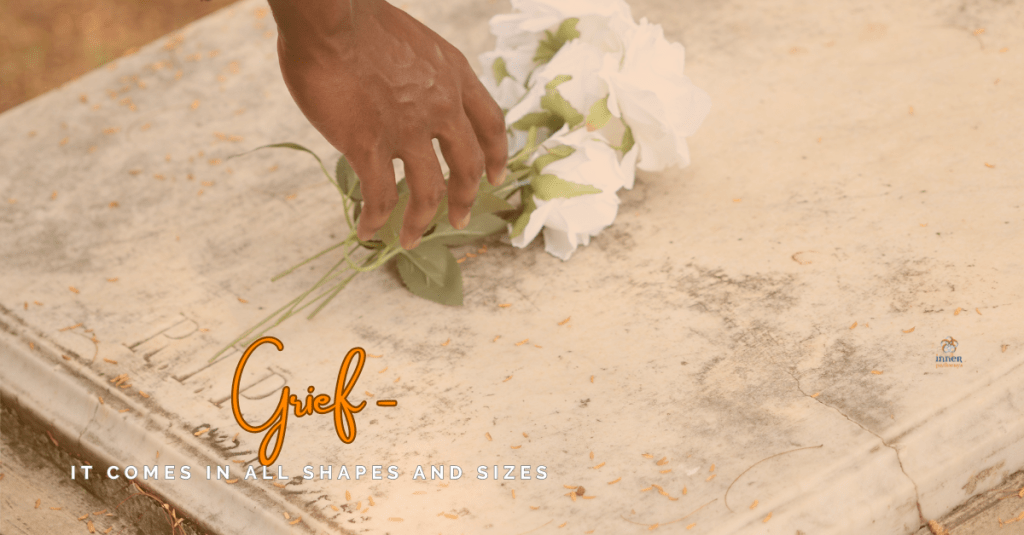
The Bit Nobody Talks About
What if you don’t feel anything?
Does that bring guilt, discomfort, or that nagging “what’s wrong with me?” feeling?
Or what if you feel too much – overwhelmed, consumed, unable to function?
Both are valid. Both are grief.
Grief is held in the Lung meridian (the Metal element). When we’re unable to process loss, our lungs – literally our ability to breathe and let go – become compromised. Ever noticed how grief can feel like a weight on your chest?
Your body knows.
From a kinesiology perspective, unprocessed grief often shows up as energetic blockages. Your heart chakra might feel closed or heavy. Your throat chakra struggles to express what you’re feeling (or not feeling).
Your body is trying really hard to tell you something.
The Ball in the Box
There’s an analogy I come back to frequently to help explain or understand grief: imagine a ball inside a box. Initially, the ball (you) fills the entire space, constantly rubbing against the box sides (the grief). It’s all-consuming.
Over time, the ball shrinks. Not because the box goes away – it doesn’t. The grief remains. But the ball gets smaller, so the moments when it hits the sides become less frequent.
You have more space to breathe, to live, to be.
The box never disappears. Some days you’ll still crash into it unexpectedly. But it won’t always be so overwhelming.
What Your Grief Needs
Whether you’re feeling everything or nothing, whether it’s been weeks or years, your grief deserves acknowledgement. Not fixing, not rushing, and definitely not comparing to how others grieve.
Just acknowledgement.
If you’re carrying unprocessed grief – the kind that’s stuck in your chest, your throat, your energy system – I’d love to support you. Sometimes we need help creating space for what we’re holding.
Book a session this month, and let’s work with what your body is trying to tell you.
Together, we can gently release what’s ready to shift.
And another quick reminder – Grief isn’t weakness. It’s evidence that something mattered. Your response to it – whatever that looks like – is exactly right for you.
While initially I did put off writing this, I also decided that I didn’t want to pop into your mailbox with a topic that you may not want in an unsolicited manner, just because it’s what I wanted to write about it (your ball might still be really big), but I also didn’t want to not write it/share it… so if you chose to read it, thank you, I hope you found it helpful.
 Inner Pathways
Leave a comment